
What is SEO? (Search Engine Optimization)
SEO stands for Search Engine Optimization. It’s the process of improving a website so it can appear more on Google (and other search engines – but mostly Google as it handles ~90% of all searches) when people search for relevant topics, services, or products.
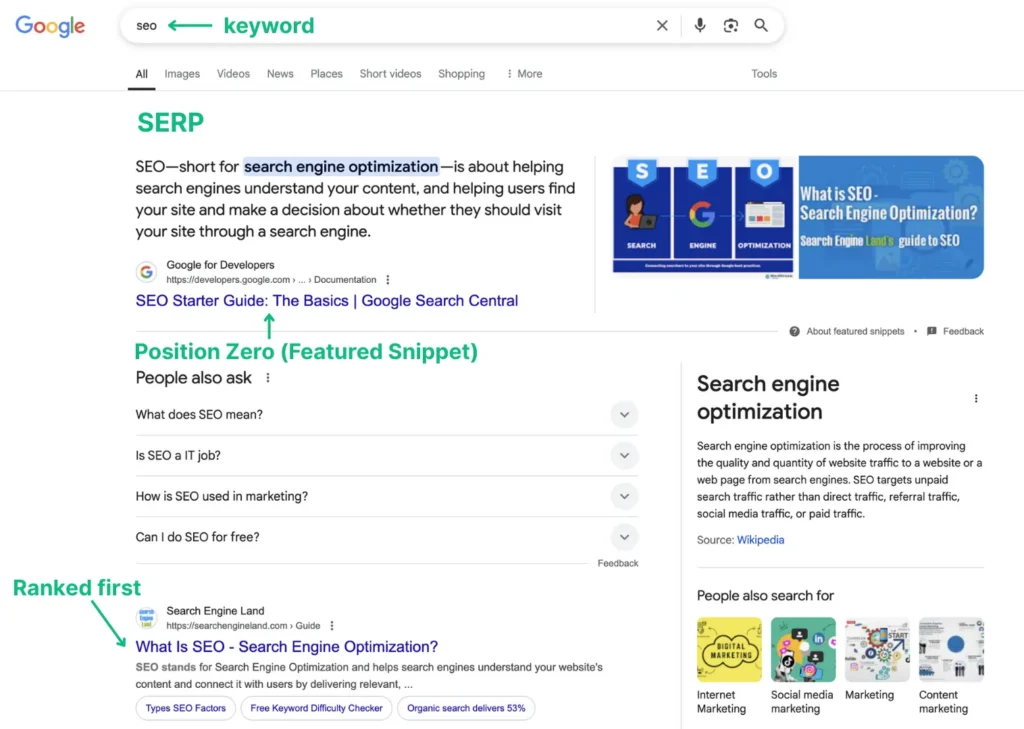
- People search for something (keyword)
- Google provides results with a bunch of websites (SERP or Search Engine Results Page)
- Websites want to be as high as possible on the SERP so they can get clicks (Ranking)
That is the short and white-hat explanation of SEO. There are plenty of methods you can use, like Parasite SEO or straight up black-hat SEO, but I will not be explaining or discussing them as I have no interest in black hat tactics.
SEO is a way to get awareness to whatever you want without paying for ads. Big and small companies, non-profits and bloggers need attention to their sites, and they, most often than not, rely on SEO to achieve it.
Why SEO Matters
Most content on the internet goes unnoticed. Not because it’s all bad (though plenty of it is), but because no one can find it.
If you publish something and it doesn’t show up in search results, it might as well not exist. SEO is the difference between sitting on page 8 of search results and showing up the second someone searches for your target keyword.
The most valuable aspect of SEO is that, organic visibility compounds. Unlike paid ads, which stop working the second your budget runs out, organic search gets you traffic for years – if you’ve done the work.
And SEO isn’t just about content. We know that business owners want leads and sales. For that, an SEO (Search Engine Optimizer) will want the site to rank for transactional and commercial keywords, which will bring leads and sales over time. And in order to do that, SEO’s typically use blogs and other types of content to gain Topical Authority.
Core Categories of SEO
There are three main categories of SEO you’ll need to understand if you want to rank:
You don’t have to master all of these at once. But if you’re serious about SEO, you can’t afford to ignore any of them either.
There’s more categories but these aren’t separate from the core categories, but more like specific use cases or layers that build on top of them:
- Content SEO
- Local SEO
- E-commerce SEO
- Video SEO
- App Store SEO (or ASO, App Store Optimization)
- Black Hat SEO
This still is not an exhaustive list. For that, I recommend Ahrefs’ guide to 68 Types of SEO if you want to learn all of them.
How Search Engines Actually Work (in short)
Google doesn’t “read” the internet the way humans do. It uses bots, called crawlers, to visit pages, follow links, and collect information. That data gets stored (indexed), and when someone types in a search, Google sorts through its index to figure out which pages best match the query.
The actual algorithm that works behind the scenes (PageRank) is much more complex, but the core idea is simple (kind of controversial, believe it or not):
Google wants to show the most useful, relevant, and trustworthy results.
Your job in SEO is to help Google figure out that your page fits that description.
That means:
- Making your content easy to crawl and understand (technical + on-page SEO)
- Matching what people are actually searching for (content + intent)
- Building signals that show you’re worth trusting (off-page SEO + EEAT)
You don’t need to know how every part of the algorithm works. You just need to understand what Google is trying to do, and match your site with that goal.
How SEO Works
Very briefly, SEO works by helping GoogleBot (The bot that Google uses to crawl content):
- Find your content (crawling)
- Understand your content (indexing)
- Trust your content (ranking)
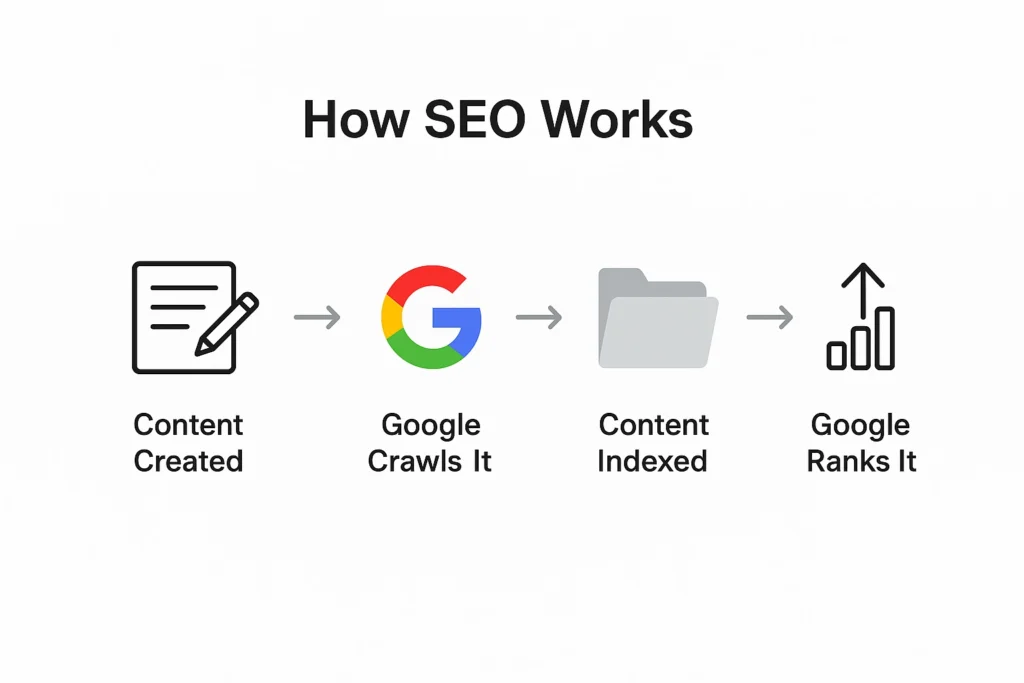
When you align your site with those three goals, SEO starts to work.
What SEO Is Not
There is of course misunderstandings about what SEO is.
SEO is not:
- A quick fix: You can’t “SEO” your site once and be done. It’s a long game, and results take time, especially if your site is new or in a competitive niche.
- Just installing a plugin: Yoast SEO or RankMath are just tools that will help you in your SEO process. They will not make you rank first in a day.
- About tricking Google: There are people who believe that white-hat SEO is a waste of time and you can rank easily with shady (at best) tactics. While true for short tem, it won’t help you in the long term.
- Only about keywords: Keyword stuffing is a thing of the past and even keywords themselves are becoming obsolete as time passes. You can rank for a keyword without putting it in your title, H1, or directly in the content. Although hard, it is not unseen and SEO is becoming more about topics rather than keywords directly. (see, Semantic SEO)
- A replacement for good content: If your content sucks, no amount of SEO will save it. And if your content is great but unoptimized, it still might never be seen.
SEO is not a magic wand. It’s a long-term strategy that you need to define and adapt as things change.
Is SEO still worth it?
It absolutely is. It can help get you leads, get ad revenue, or sales. Automation helps, but SEO still requires intent, analysis, and judgment.
Common SEO Myths
- “SEO is a one time thing.” → It’s not. You’ll need to update, adapt, and compete.
- “Good content ranks on its own.” → Not without proper structure and targeting.
- “More posts = more traffic.” → Only if they’re actually useful and optimized.
- “Keywords are everything.” → They help, but they’re just one piece of the puzzle.
Where to Start
If you’re new to SEO, don’t try to learn everything at once. Start with the basics that will actually do something:
- Make sure your site is crawlable: If search engines can’t access your pages, nothing else matters. Tools like Google Search Console will show you what’s being indexed and what’s not.
- Understand what your audience is searching for: Use tools like Google Autocomplete, AnswerThePublic, or any basic keyword tool to get a feel for real search intent.
- Optimize your existing content first: Fix titles, add relevant headings, improve page speed, and clean up internal links. You don’t need more content, you need better structure.
- Build topic clusters – not random posts: Pick a core topic, then build related articles around it. This builds authority and helps Google understand what your site is about.
- Track results early, but don’t obsess: Set up Google Analytics and Search Console. Then give things time, SEO is slow by nature.
- Learn where keywords actually belong: Titles, headings, meta descriptions, intro paragraphs, and internal links. Not spammed everywhere.
Start small. Do it right. And when you’re ready, start learning more on on-page, off-page, and technical SEO.
